

Welcome to Exemplar, the Benchmark Human Services (Benchmark) company newsletter. Enjoy, and please contact our Development team with any questions: [email protected].
Innovative Solutions for Critical Moments
By Brian Gill, Vice President of Behavioral Health and Crisis Services
In an era of unprecedented demand for behavioral health services and the resulting need for immediate, expert intervention, Benchmark Human Services has emerged as a national leader in mobile crisis response—transforming how individuals are supported and treated during their most vulnerable moments.
With nearly two decades of experience in this field, Benchmark provides trauma-informed mobile crisis services across multiple states, responding to thousands of crisis situations every year. We use evidence-based practices that prioritize safe, community-based care over institutional placement.
A Model Built on Proven Results
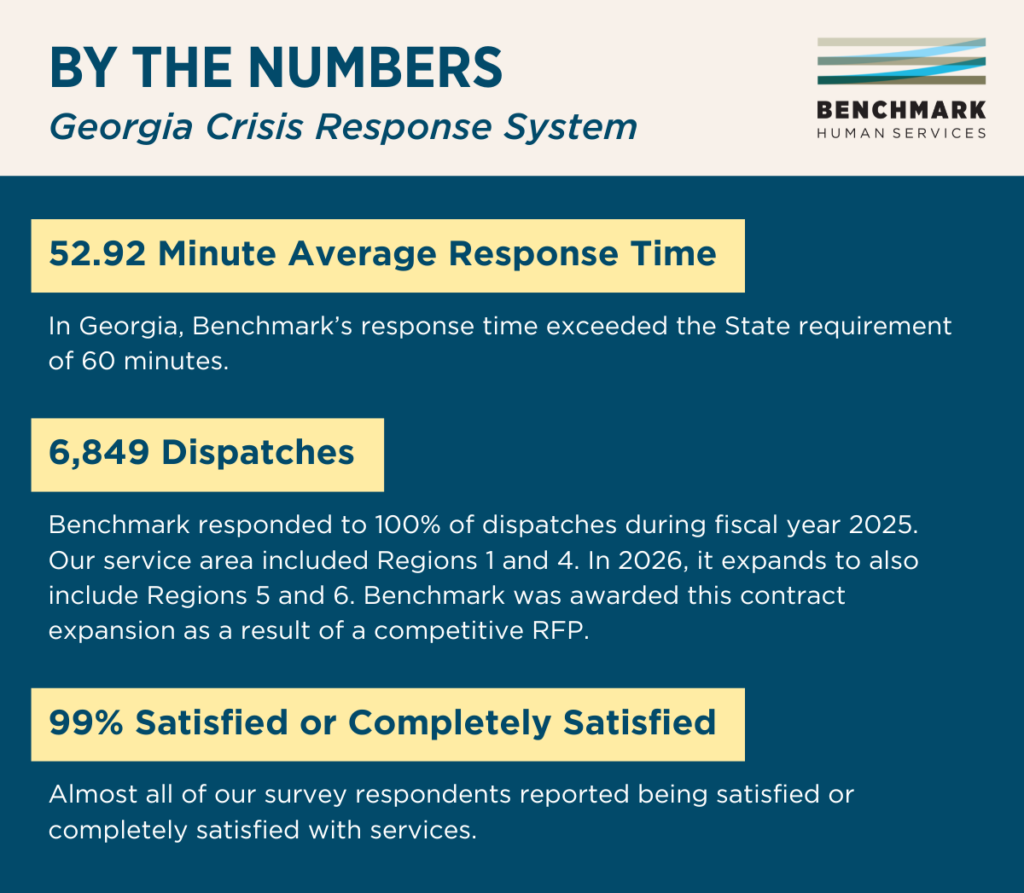
Benchmark’s success in behavioral health crisis services stems from our commitment to measurable outcomes and continuous quality improvement. In Georgia alone, our mobile crisis response teams achieved a 100% response rate to almost 7,000 dispatched calls in fiscal year 2025, maintaining an average response time of 53 minutes—consistently meeting the critical 60-minute standard. Among survey respondents, 99% reported being satisfied or completely satisfied with services received.
These results reflect our commitment to serving those in crisis with respect, ensuring the health and safety of all those involved. This work is accomplished through teams comprised of licensed clinicians and certified peer support specialists who deliver face-to-face interventions to stabilize the crisis and provide ongoing support to ensure a successful handoff to the services and resources needed to maintain the individual in the community. This model demonstrably reduces psychiatric hospital admissions, emergency department utilization, criminal justice involvement, and placement failures—outcomes that benefit both individuals and the systems designed to support them.
Scalability and Customization
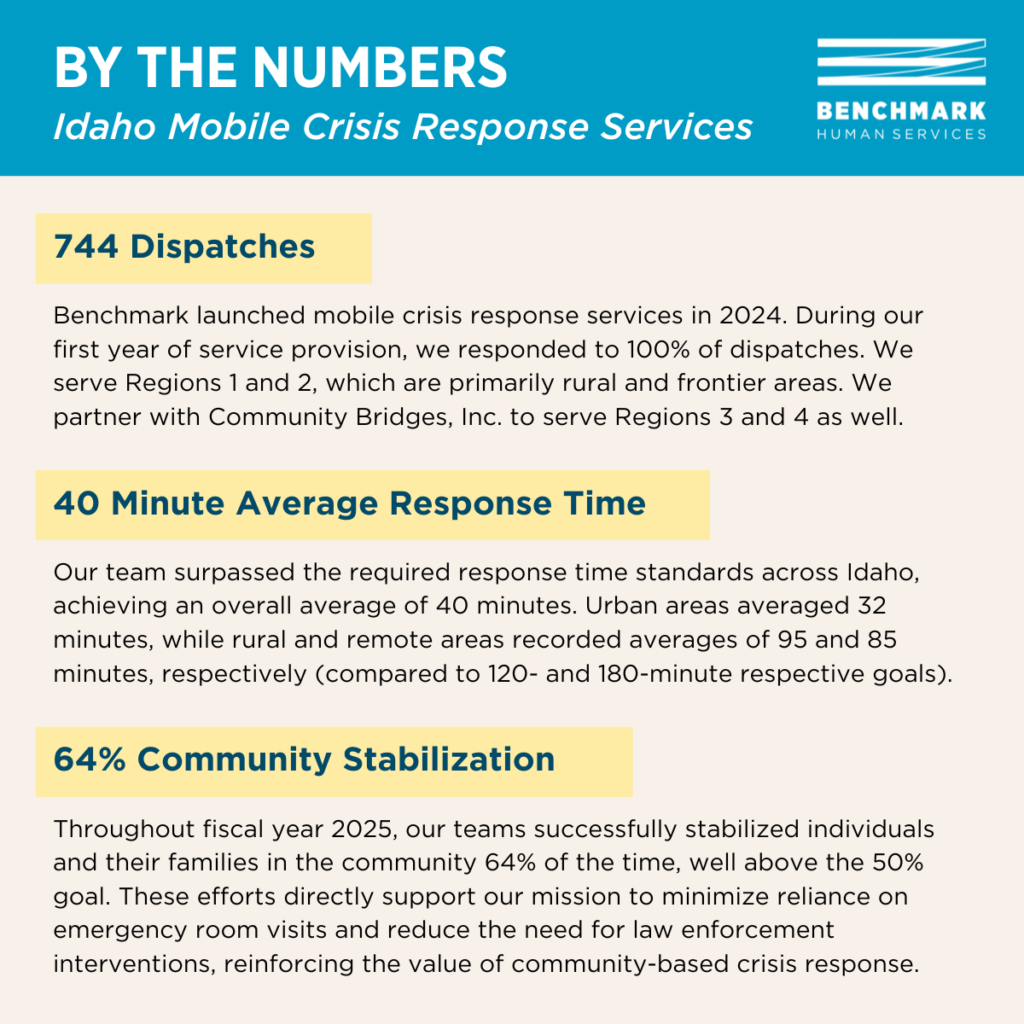
Benchmark’s expertise extends beyond service delivery to systems design and implementation. We have successfully launched mobile crisis programs in Georgia, Idaho, Indiana, and Oklahoma, serving catchment areas encompassing more than 220 counties across both rural and urban environments. Our service design allows state agencies and managed care organizations to customize programs according to geographic scope, population needs, and budgetary parameters—from comprehensive statewide systems to targeted regional initiatives.
Recovery-Oriented, Community-Focused Care
At the core of Benchmark’s crisis intervention model are three essential principles: peer-based support that leverages lived experience, collaborative community partnerships that unify resources across systems, and recovery-oriented philosophy emphasizing hope, self-direction, and trust-based relationships.
As state agencies, healthcare organizations, and payers nationwide work to develop a more responsive and robust crisis system, Benchmark offers proven expertise in creating accessible, efficient, and effective crisis services that support individuals and their communities during critical moments.
For state officials and organizations seeking to enhance their behavioral health crisis capacity, Benchmark represents a partner with demonstrated capability to deliver measurable outcomes while maintaining an unwavering commitment to the health, safety, and respect of every individual served.
Contact our Development team to learn more about how we can bring innovative crisis services programs to your State: [email protected]
Where Potential Leads
Benchmark Human Services operates in 20 states and serves more than 23,000 people annually. Our leadership staff come from all walks of life and support people through a variety of programs and services.
In this series, we will get to know leaders from across the country. To start, we hear from Jaime Garza, Ph.D, who serves as our Director of Crisis Services in Idaho.
Tell us about your experience in crisis and/or mental health services. What inspires you to do this work?
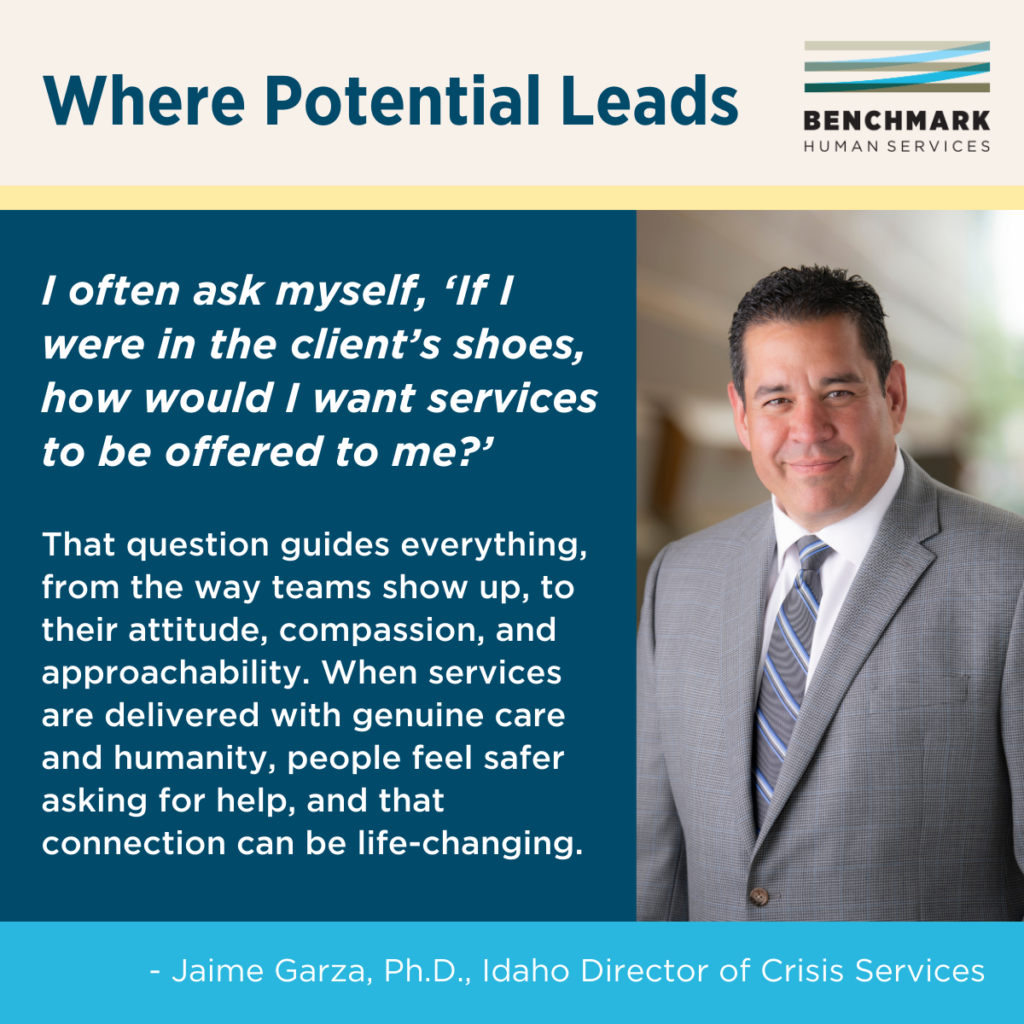
As someone with lived experience in both mental health and substance use disorder, I know firsthand how difficult it can be to ask for help. That experience has shaped my entire approach to this work. As a leader, I see it as my responsibility to break down barriers that make it hard for people to reach out, connect, and ultimately receive support that could save their lives. I often ask myself, “If I were in the client’s shoes, how would I want services to be offered to me?” That question guides everything, from the way teams show up, to their attitude, compassion, and approachability. When services are delivered with genuine care and humanity, people feel safer asking for help, and that connection can be life-changing.
Working in mobile crisis response services can be intense. How do you support your team?
I strongly believe that we rise to the level of our training, not simply the expectations placed on us. Because of that, I prioritize making sure my team is well trained and prepared for a wide range of situations. At the same time, I emphasize that it’s okay not to have all the answers. When staff encounter situations they haven’t faced before, they are fully supported. Just as we encourage clients to ask for help, I want my team to know they can do the same. This work is a community effort. When challenges arise, stepping back, leaning on one another, and addressing crises together is how we sustain both our people and the services we provide.
What principle(s) guide your work?
My work is guided by faith and love for others. Compassion is the foundation of how I lead and make decisions. Even when difficult or uncomfortable choices need to be made, I try to approach every situation by asking how a person can grow from the experience and how I can support them through it.
I believe tough situations don’t always break people, they often make them stronger. As long as decisions are rooted in compassion and a commitment to do no harm, I trust that even challenging moments can ultimately serve someone’s long-term well-being.
Leston received services from Benchmark’s Active Consulting program. Prior to his involvement in this program, Leston spent 130 days in jail following a property destruction incident.
Through a collaboration between Summit Community Care, St. Francis Area Developmental Center, and Benchmark Human Services, Leston is now enjoying life in the community.
Upcoming Conferences
Open Minds Performance Management Institute | February 10 – 12
Three of our company leaders are headed to Clearwater Beach, Florida. Doug Beebe, Dr. AJ Beyrer, and Sarah Chestnut are looking forward to the Open Minds Performance Management Institute.
Will you be there? Send us an email and we’ll find a time to connect: [email protected]